3.21.2007

Innocents Abroad

Yesterday afternoon we returned to our little hostel in Labone tired, dirty, and so happy to see our ugly iron front gate again. After a shower, nap, and pizza dinner, I felt happy to be home -- walking to class this morning, however, was another story. The baking heat, unbearable stench of open sewers, and unwelcome attention of random men made me long for the cool, clean, friendly villages in the Volta region where I spent the last 5 days. We swam in rivers and waterfalls, climbed the tallest "mountain" in Ghana, and met an extraordinary range of people on our travels up the Volta lake, across a small section of the North, and down through the forrested Volta region. What follows will be an attempt to chronicle our itinerary and all the thoughts running through my head on those long tro-tro rides...

PHOTO: Dave lounging in the hammocks at Akosombo

AKOSOMBO: We started at the site of the Volta Dam which makes the Volta Lake and the vast majority of Ghana's electricity possible. Day 1 was the halting tro-tro ride from Accra, and the one day when Dave wasn't with us. It made me appreciate the 2-guys-2-girls dynamic later on in the trip - Ghanaian men are always trying to ask if you are married or dating, and when there's another guy with you it's convenient. One guy with two girls was, ah, confusing for them. Day 2 we spent swimming and canoeing with a group of young boys, and I think it was one of the most relaxing days I have spent here. The nightly tradition of the "juice box," (cheap wine in a carton) guitar, and intense conversations also started in Akosombo.

YEJI FERRY: Day 3 was the waiting day. We had planned pretty much the entire trip around taking this ferry up the Volta Lake to Yeji, and we spent Monday waiting for the ferry to depart. While Dave and Netanus went to town to buy food and Dan wandered, I made friends with a couple of British guys who were setting out on a 16-day travel itinerary after 2 months of volunteering as teachers in Accra. We ended up setting up camp next to the British group on the top deck of the boat that night, and were having a great time with some Ghanaian beer and Beatles songs until an elderly neighbor told us to be quiet. Day 4 we spent waiting as well - waiting for the boat to reach its destination. There was lots of reading and writing and sleeping in the sun that day, and lots of conversations with fellow travellers, mostly Europeans. It really struck me for the first time what a priviledge it is to travel, and how strange the concept seems to people here (and, I would imagine, in many parts of the world). The idea of going someplace just to see it is strange here - even stranger is our desire to sleep outdoors and do silly things like hike and swim, but more on that later.


Tuesday night we arrived in Yeji after dark and joined a surreal procession into the village. The only light was the floodlight from the boat, reaching up the embankment into a swirling cloud of mosquitoes. We didn't know where to go for a hotel, but an anonymous guide told us to follow all of the other people, so that's what we did. This strange procession of foreign backpackers and Ghanaian women with giant loads on their heads wound up the hill and into the town, and eventually we found ourselves at a rather sketchy and overpriced hotel where the manager could not understand why the two girls wanted to sleep in one room together and not partner off with our male companions...

PHOTOS: Hanging out on the boat (Netanus's picture) and Dan's morning ritual on the ferry Tuesday at dawn

BIMBILLA: Day 5 was our roughest travel day. Early the next morning we met our same guide again, and walked down to the water where we boarded an enormously overpacked canoe that took us across the northern tip of the lake. At the next town we packed into the most crowded tro-tro I have ever been on (where we ran into our British friends and a few other familiar foreigners) headed to Tamale. We hopped off at Salaga and immediately found a ride to Bimbilla, allowing us to save a day of travel up to Tamale and then back down to Bimbilla. The price we paid for this more direct route was the tro-tro ride from hell. Most of the used vans that serve as tro-tros in Ghana are in poor condition, but this one was literally falling apart. I was convinced that the back doors or side panel would fall off. An hour outside of Bimbilla, something that sounded very much like a wheel axle made a large cracking noise, and everyone pilled out of the vehicle. After about 10 men looked at the wheel for 15 minutes, they decided we could get back in, and on we went. I spent the next hour terrified of dying in a typically Ghanaian accident, but the car managed to hold together until Bimbilla.

PHOTO: Grass and mud huts in Bimbilla (Netanus's picture)

The town itself was lovely and calm, with bicycles largely taking the place of cars on the dirt roads. There were children everywhere, all wearing various school uniforms (though this could have just been because our guest house was near several schools). Our Twi was pretty useless here, and it was difficult to find people who spoke English, which made finding food and the tro-tro park an interesting adventure. But everyone we met was incredibly nice, and it felt good not to have children and adults grabbing onto us everywhere we went. (Everywhere I have been in Ghana the children are different, though there are always so many. In Bimbilla they were mostly shy and quiet, though they came running from all directions to be in photos.)

HOHOE/LACKHAM: Day 6 went smoothly enough for a 4.5-hour tro-tro ride in which we passed from the brown of the North to the green of the Volta region. After some disagreement among some hot and tired travelers we decided to take a cab to Lackham Lodge, which turned out to be a brilliant decision. The first night there it rained, the first rain we had experienced since coming to Ghana. So, naturally, we celebrated by running around and doing cartwheels in it. Then we bought beer. The Ghanaian lodge employees thought we were insane.

PHOTO: the view from the top of the mountain above Bowire-Lackham

The next morning we tackled Dan's mission for the day: climb the ridge behind our lodge. After picking our way through some forest paths, we found our way to the nearest village where we luckily ran into a son of the village chief. He arranged a small semi-formal meeting between us, the chief, and two other elders in which we exchanged some cedis and a book of Alan Ginsberg poetry (thanks to Dan's generosity) for permission to climb the "mountain." They sent us up the steep path with 5 Ghanaian guides, and on our return we drank palm wine with the village elders and passed around our digital cameras with pictures of the view from the top. It was one of the most classic "Africa" days of the trip, the kind of adventure you could never plan using the guidebook.

HO: We rejoined our program directors and the other CIEE students Saturday in Ho at Chances Hotel, complete with AC and a beautiful pool. We got free food and transportation for the next two days, and visited two community eco-tourism projects: a monkey sanctuary and Wli Falls, by far the most impressive waterfall in Ghana.


It was a wonderful break from the road, and we had a chance to share our stories with our other friends who journeyed up to Mole Park and more of the Northern region. After some serious internal debating, I decided to keep going for the next two nights, which I think were maybe the hi-light of our trip.

PHOTOS: CIEE students walking into Wli Falls; the incredible cloud of bats circling the top of the falls.

CAMPING: After the official CIEE field trip finished (and after some serious indecision) I decided to extend my spring break for another two days. We had the CIEE bus drop us at the visitor's center in the town of Likpe Todome, which was an old church building with nothing inside except for one small table and several posters of the surrounding sights. We had come to the town to visit the caves, and after a quick reapplication of bug spray and sunscreen we were off for our second hike of the day, hurrying to make the loop back to town before dark. The hike up to the caves was intense but short, and absolutely worth it. The cave tour was unlike anything you could legally experience in the US - our flip-flop-shod guides tooke us scrambling up narrow crevices and across faces of rock with only the help of a few sturdy ropes, and nothing close to a liability waiver. But we overcame our respective fears (of falling or getting stuck in small holes) and had an amazing day. We rushed down from the hills to make it to our guest house just before the sky opened up with the second rainstorm of the week.


Monday morning we caught a tro-tro back to Hohoe where we ate, stocked up on food for camping, and found a cab to take us to Liate Wote, a town from which we would hike what the guidebooks call the tallest mountain in Ghana, Afajado. What you have to remember is that West Africa is not exactly mountainous. What we actually climbed was a horribly steep trail up a miniature mountain, only to find, at the top, another peak right next to us that was clearly taller. As it turns out, this other point is not considered a "mountain" since it is just the highest point on a long ridge. Boo. But the view from the flat, baking-hot mountain top was still amazing, and the camping Monday night was definitely worth the climb. We cooked beans on our little fire and fashioned tents out of boulders and mosquito nets. We also watched a lightening storm. Yes, from the top of the tallest mountain in the country. It was amazing.

PHOTOS: Alex on the climb up Afajado, the fire at our mountain-top camp site the last night

On our way back to town Tuesday morning, we had the only real blood of the trip (and so close to a clean finish!) when Dan lost in the fight with the garbage bin. Turns out a jagged beans can cut him in the hand, and we made a side trip to the government hospital in Hohoe. Luckily for everyone the wound wasn't bad enough to need immediate treatment, because we probably would have spent the whole day in that hospital. Once this was clear, we made for the tro-tro park and an early departure for Accra. (Turns out Dan didn't need stitches after all, though he might have a nasty scar on that hand.) So Tuesday afternoon we were home, extremely dirty and tired. A week later now, I'm not sure if I am happy to be back or not. There is certainly less to do in Accra than there used to be (with two classes no longer meeting and most of the sights already seen) but I'm not worried - we're heading out of the city again this weekend.

3.09.2007

Ghana @ 50!


Ghana @ 50, the celebration of 50 years of "freedom," has been perhaps the most hyped aspect of my visit in Ghana, and I have to say that the day itself lived up to the talk. We somehow got the (very silly obruni) idea to walk through Osu to Independence Square, an enormous expanse of concrete the guidebooks like to mock. It may be a ridiculous use of beachfront property most of the time, but on very special occasions it becomes an amazing place to be.


In terms of descriptions, I think the photos speak for themselves pretty well. We survived the crowds, my camera was not stolen (despite a few attempts), and we only lost one of our friends. While she was lost, however, before fleeing back to the hostel, she took a lot of great photos, many of which I have stolen and displayed here. If you have ever been to a city in Africa, combine that level of disorder with the kinds of crowds you might find on the mall in D.C. on the 4th of July, and you have some idea of what the day was like.


The afternoon held a rather different sort of celebration for us, as we all visited the juvenille detention facility where one of our friends volunteers as a teacher. We brought FanIce (really creamy ice cream) and Netanus's enormous drum, and what we got was a group of young boys, aged 6 up through 16 (at least) drumming, dancing, and playing with our digital cameras. Some of them were absolutely adorable, and as with most interactions with children here, I felt vaguely guilty leaving. I know that caring for children is not what I am best at (which is why I have decided to do my volunteering for the West Africa AIDS Foundation doing outreach and education work) but I still always feel like I should be giving more of my time to these kids who obviously love the attention.


For now I will refrain from any more discussion of NGOs and aid and guilt, which I just wrote a 5-page paper about, and just let you enjoy the pictures. Ghana is 50! I never grow tired of listening to Ghanaians argue about whether or not real progress has happened in those 50 years. Maybe by the end of my stay here I can tell you.

PHOTOS: the crowds in Independence Square, the photo Netanus got lost to take, Josh dancing in his flag, then drumming and dancing with the kids

NOTE: I will be travelling for the next week or two (the entire trip is TBD), so I will be unfortunately out of touch, though I may be able to get in to an internet cafe in between buses and "mountain"-climbing. There will be many adventures and reflections to share after my travels in the Volta region, mainly what the ethics are of being a "tourist" in a place like Ghana.

3.05.2007

Henri's

When we first showed up it didn't look like anything special - a collection of plastic chairs arranged around plastic tables on the sidewalk. The music was the usual mix of hip-life and American hip-hop, and the drinks were the usual Ghanaian beers. It wasn't until we went inside that Henri's began to look like the super-secret gathering place friends had told us it was: a gay bar.

That's right, a gay bar in Ghana. If you know anything about the nature of homosexuality in African culture you will appreciate how unique a place Henri's is. As it turns out, there are several bars and clubs around Accra known (though not to the general public) as gay bars and clubs. They have to be something of a secret, though, because of the intense level of homophobia here.

Traditional African society supposedly does not include homosexuality - it simply isn't part of the culture, according to a few articles I have read. There are no gay people in Africa, theoretically (or were none, in some imagined precolonial past). In some ways, this denial of the idea of homosexuality allows men of any sexual orientation to behave in ways that would be considered feminine in the U.S. - men can hold hands, dance together, and be otherwise physically close with other men, and these behaviors are not considered sexual at all. But at the same time, being openly gay is nearly impossible, especially for native Ghanaians.

Of course this does not mean that there are actually no gay people in Africa, or that people here do not understand what this means. Cultural imports from the West, from television shows to magazines, have introduced the idea, though even in the wealthy, Western-friendly district of Accra where I live, this does not translate into acceptance. The homophobia is apparent in everyday conversations, where single men who aren't sexually active (for reasons not explained by religious commitments) are *accused* of being gay. Being "out," even in Labone, would certainly involve social ostracism, and in other areas a real risk of violence.

So the community is underground. But it still exists, as one of our closeted Ghanaian friends showed us this weekend. In some ways Henri's was not so different from gay bars in New York - there were plenty of tight T-shirts, lots of dancing, and even some bad 80s music, though no fancy drinks. But when you walk back out of the poster-covered sliding door, you could be at any "spot" in Accra, which is clearly the point.

3.01.2007

Kumasi and Kente

I'm overdue for an update here. I finally managed to get photos online (Facebook) after a complicated process of trial and error that involved borrowing one friend's Mac (thank God she disobeyed CIEE's advice and brought her laptop) and another friend's tiny flash drive. All this means that I am far less depressed concerning computer matters and ready to write a decent update.

Last weekend was our third CIEE-sponsored weekend adventure. I neglected to describe the first one (which was four weeks ago) sufficiently, mostly because I was not able to post my pictures. We traveled to Cape Coast, the original colonial capitol of the Gold Coast. The faded city is home to a beautiful old fort with a dark historical role: it was a major port in the West African slave trade, where various kingdoms sold untold numbers of captives to the European traders. (As an important historical aside: chiefs did NOT sell their own people into slavery as some uninformed romantics like to spout off as one of the horrors of the slave trade. It was members of rival clans or ethnicities that were captured and sold, etc. People originally from all over West Africa passed through the slave dungeons of Cape Coast. Most were probably not from Ghana itself.) All of this is difficult to imagine in the bleached-out beauty of the castle today. We also went to Kakum National Park, a rainforest reserve, and traversed the famous canopy walk - giant rope bridges strung through the biggest trees of the forest canopy.


Now that we are caught up on the Cape Coast trip... this past weekend we made the much longer and more difficult journey to Kumasi, the city at the heart of the Ashanti Region. The journey itself is a story: we became stuck in an enormous traffic jam in which our bus and every other vehicle remained stopped for more than an hour. Turns out, a large truck had either overturned or broken down in the road (depending on the rumor you chose to believe) and THEN the fork-lift sent to clear the road also broke down. Only in Africa...

When we finally reached the city, we rushed to the military museum in which we received a very animated and fast-paced tour of Italian guns, a box full of human remains, and lots of very old photographs from a guide who must have been on caffiene at the very least. He really dramatized the story of the Asante's last battle against the British, even if his historical facts were a little fuzzy.


The next morning was a blur of artist communities. We started with kente, the traditional woven cloth of the Asantes in which different weaving patterns have different meanings. Next was adinkra printing, in which different symbols are printed onto woven cloth. A wood-carving village rounded out the day. Each stop was meant to be an educational presentation and investigation of a certain type of Ghanaian art, but in the end each place became a sort of shopping mall. I came away from the day with some beautiful kente I probably paid too much for, and a wooden statue that (I think) I got a really good deal on. Was it worth the hassle and the half-dozen "salesmen" literally grabbing me? I'm not sure. But apparently there is no other way to make a purchase in this country.


Another thing that struck me about Kumasi that we didn't really experience in Cape Coast was the children. Every place we visited outside of the museum, there was a crowd of children and young teenagers waiting, holding their hands out for gifts that we hadn't thought to bring. (It's amazing, but colorful pens and small candies go a long way.) Each time our bus pulled away, leaving the crowd of reaching hands behind, I had a sick, guilty feeling in my stomach. I know there is no real change to be brought by change and gell pens, but I wonder if that bus takes us through this country with a bit too much glass between us and, well, the country.


PHOTOS: Canopy walk in Kakum, kente looms and cloth for sale, Natalie making an adinkra print, the view on the way home from Kumasi

2.21.2007

Guarded Friendliness, also known as The Trouble With a Walk to the Bank

Just like in most study abroad experiences, there are good days and bad days in Ghana. (Today was actually a good day, but I still feel the need to write about this.) There are great days where you go out into Accra or beyond (especially beyond) and get the feeling that you are really seeing Africa, and that you get it. But there are also bad days, days when the water doesn't run, the food makes you sick, or too many men pester you with marriage proposals. It is the last of this list that I want to try to explain.

In Africa, or at least in my experience in Accra, you learn to approach certain people and situations with a sort of guarded friendliness. It is a reflection of the economic situation in Africa that there are many unemployed men that have little better to do than sit around on the sides of the streets, and these are the people to avoid. It is certainly easier if you are a guy, and easiest when you are with Ghanaians, but for a white female walking down the street alone, just getting to the bank (or grocery store or anywhere else) and back can be quite an ordeal. Especially in an affluent district like Osu, all white people are assumed to be rich, and there is never a shortage of people who want to sell you things or simply ask you for money (or declare their love for you). People will approach you with "hello, what's your name?" which seems rude to ignore, but this "conversation" will get to "have a look at my jewelry" or "please, give me money" in about 2 minutes. Really less. If they don't have anything to sell, they want to "be your special friend," they ask for your phone number and say "when can I see you again?"


And it's incredibly frustrating, not because I can't say no, but because outings like this, especially when I am alone, force me to put on a mask of guarded friendliness in which every gesture, facial expression, and word has to be chosen to make me seem unapproachable. But when someone does approach you, it rarely works to completely ignore them. The trick is to be friendly and polite while still preventing the conversation from continuing. It's a tough balance to keep, but there are ways.

Body language helps a lot. You can say "no" as much as you want, but it won't help if your body language is open for interaction. For example, I learned from a Nigerian friend here to wave instead of shaking the hand that someone holds out. She says she does it because you never know where a hand has been, but it also serves as a way of keeping yourself separate from someone you don't really want to talk to. You can wave and keep walking, instead of being pulled into a conversation. It helps a bit to smile too, but I think the most important thing is to keep walking, and to look like you know where you are going (which I do now!). I've also heard advice to say "not today" or "maybe next time," something to that effect. It isn't as effective as I might have hoped, but it is probably the easiest thing to say, rather than explaining that you are a student without much money, etc. etc.

The worst part about this, as I said, is not that it is difficult to get out of certain interactions. Sometimes men are really persistent, especially when it's just girls, but I have not yet been in a situation where I really felt in danger. (But some other girls in my program have had much more physical run-ins with guys on the street. One of my friends basically got groped in this really busy market-place, and turned around and yelled at the guy. I like to think that my "New York face" has some effect, but maybe I've just been lucky.) The worst part is that it makes you wary of any new person you meet. They might not even be "new" - a student I met once might not be familiar to me, but of course they recognize the blonde girl. Even walking around in our neighborhood in the afternoon can be challenging - I usually err on the side of friendliness, because even if I cannot recognize someone, they are most likely a neighbor or shop owner, and at any rate there aren't really any street hawkers in Labone. But there is also a palm wine "spot" (i.e. benches of unemployed drunk men) on the walk home from school, which can be a little scary at night.


I don't want anyone to worry about me. Even when you are new to Accra, the worst that usually ever happens is that you give out your phone number or cash to too many people, which really just results in being broke and getting lots of annoying phone calls. The toll of these types of interactions is more emotional. It's getting your personal space and security violated, it's hating the way you have to be rude to strangers, it's feeling like you always stand out. And it can make the difference between a good and bad day here.

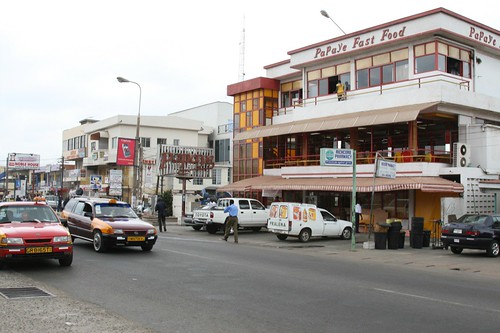
PHOTOS: (borrowed from the web) Oxford St. in Osu

2.15.2007

Val's Day and Other Reflections

February 14 is a major holiday in Ghana, and although there is certainly a strong romantic element, it isn't a holiday only geared towards couples like it is in the U.S. There are parties, concerts, and all sorts of other social events - it might be the busiest Wednesday night I've seen here yet. It is also known as national chocolate day (cocoa being one of Ghana's biggest exports) which I personally think is a whole lot better than all of that romantic stuff.


Besides the chocolate, though, Val's Day (as a lot of people call it here) turned out to be a surprising window into Ghana's sexual culture, as well as a really fun night out. In Leadership 4 (a course for Ashesi seniors that focuses on how to be a community leader) on Wednesday we had a speaker from West African AIDS Foundation come to talk to the class, and some of the reactions were quite startling. Before the speaker showed up, the professor asked a few questions to start up a conversation on sex and love. What was stranger to me than the comments was the general mood - the giggles and jokes made me feel like I was in a middle school classroom. When the NGO worker later asked how many students had ever had an AIDS test, only one Ghanaian student raised her hand. (I should admit here that I have never been tested myself, but at least I know how and where to get tested, and I'm not afraid to talk about it.) In discussions later about the class, we (the CIEE students) couldn't decide whether students at Ashesi really aren't having sex, or whether they just don't know how to discuss it. I wonder how many students will take advantage of the AIDS testing that will soon be available on campus.

On a less serious note, Valentine's Day was also a great opportunity to go out (on a weeknight too, a strange rarity here), and I experienced something of a breakthrough in my mentality towards nightlife here. I ventured out (in red pants) with two other American girls, and we eventually made it to an outdoor concert designed to raise awareness about AIDS. (Continuing the theme from above: one of the MCs, after promoting the use of condoms, suggested that women could also use "that pill thing." Um, no, that won't work. What the hell. Right in that moment I understood a huge part of the problem of AIDS prevention in Africa.) But the storyline that took us from our hostel to the concert and back includes several other stops that weren't exactly planned, which is the way most days and nights out unfold in Ghana.


The difference is that on Wednesday night I was fine with it. We were with our program assistant's younger brother, but perhaps more important than that was our own growing confidence in our knowledge of Accra. For the first time, I wasn't worried about how things would turn out, because I knew that whatever happened, we could always walk out and get a cab and direct the driver home. These are some basic urban survival skills that I didn't have when I walked off the plane; I didn't know how to bargain with the cab drivers, I didn't know my way anywhere, I didn't even know where to buy groceries or how much they should cost. But now I am comfortable in this city. It's still no Manhattan - without streetlights, public transportation and reliable police, it will never be as safe. But I know how to navigate through all of that now. Now it's time to relax and have fun.

PHOTOS: the fishing boats at Cape Coast (stolen from Netanus), schoolchildren just outside Accra

2.12.2007

Lost in Translation

One of the luckiest things about me studying in Ghana (I had originally planned on Senegal) is that the official language here is English. Not that everyone here speaks English, or speaks it in a way that is intelligible to an outsider. Cab drivers, market women, artists, and many of the people you encounter away from the university setting will tend to speak more of a mix of incorrect English and Twi or other indigenous languages. Yet even when speaking with classmates and professors at Ashesi, (all of whom are well-educated, many of whom are also well-traveled) so many things seem to get lost. For a long time I thought my roommate was in the same year as me - it turns out she is a first-year, not a "junior" in the way I meant. I'm still under the impression that we are the same age, but who knows, that could be wrong too.


For example, the use of "please": it is interchangable with "thank you" and sometimes even "you are welcome," and it can generally be thrown into any sentence to make the language more polite and formal. "I'm coming" is also tricky - what it really means is "I am going, but I will be back," and the time frame is undetermined. (This is a common theme in Ghanaian culture - everything is always "soon" and "coming" and "close," but often these things are a long time or a far distance away.) As you can imagine, this can make for some frustrating misunderstandings.

Just like in British English, there are specific words for certain objects or concepts that are used slightly differently than they would be in the US. (I once asked a bartender for a "napkin" - he sort of frowned at me and shook his head and was like "how about a tissue?" and handed me exactly what I had asked for.) Ghanaians use "cutlery," not silverware, they "wash," they don't shower, (though perhaps this is a helpful distinction as our "shower" rarely works as such) and "chill" means the exact opposite as it does at home - "chillling" means going out to a bar or club until 2-3 am, not sitting around at home watching a movie. I figured this one out as a friend asked me incredulously why we were "chilling" the night before we had to board a bus at 7 am.

My favorite misunderstood concept would have to be "ponding." Pronounced the Ghanaian way, it sounds more like "pounding," which makes sense as a form of punishment. Turns out, the word is "ponding," as in putting someone in a pond. Yeah. Apparently it is a great source of embarassment and public punishment for the members of a certain fraternity.


The mistranslations are mostly humorous, although understanding taxi or tro-tro drivers can be a real problem. Of course the accent here is different, and what we have learned is that it often helps people understand you if you pronounce your Ts a bit more, and your Rs a bit less (as in "water" - imagine pronouncing the first half of the word like a British person, and the second half as "ah" instead of "er"). So don't be surprised if I come home speaking English a bit funny.

PHOTOS: Cape Coast Castle, the rainforest view in Kakum National Park (stolen from Netanus)

2.06.2007

African Journalism: I

I envision this entry as the first in a series about journalism in Africa, or, more accurately, journalism in Ghana. I hadn't really expected to be a "journalist" here (I don't really think blogging counts). I was content to be a "student," occassionaly a "tourist," and perhaps even a "political scientist," but because of the people I happened to meet, I find myself being drawn once again into the journalism world.

But that world here is entirely different. "Community journalism" becomes an entirely different concept in a country where the biggest, most well-respected newspaper is literally run by the state. As recently as eight years ago, journalists had to flee the country to avoid arrest for writing anti-government pieces, and even now publications can be more or less destroyed by lawsuits filed by the government which charge editors with libel for writing against the party in power.

Today in Twi class (the local language which I am only sort of learning) we heard the remarkable story of our teacher who lived in Nigeria in 1999 in order to escape arrest by the military. He had written a story incorrectly placing the president at the scene of a beating (the man was in fact one of two look-alikes, if I understood his story correctly), and as a result, soldiers came to his house while he was away and took all of his books and papers, including his passport. He escaped through Cote d'Ivoire, and is now back in Accra. It sounds like a truly extraordinary story, especially to have taken place so recently, under a supposedly democratic regime.

Thoughts of a senior thesis on democratization in Africa are turning in my head, and the more I think about it, the more freedom of the press seems like a logical aspect to explore. I can see several visits to newspapers and radio stations in my future. Good thing I brought my tape recorder.

2.05.2007

The Clearing Harmattan

Even though the Harmattan is clearing, there is still dust everywhere on the ground which will continue to bake until the rains come, supposedly in late March. But water hasn't been behaving as it is supposed to in this part of the world; the Volta River -- and the amount of hydro-electricity produced by its dam -- is lower than it should be, which means our taps and lights work only occasionally. These are the signs and effects of global warming; anyone who doesn't believe the scientists should come to Africa and feel it in the flesh.

A few weeks ago Ghanaians were complaining of the "cold." But the dry, sandy winds from the Sahara are diminishing, and the tropical sun is shining ever more intensely down on Ghana. At less than 5 degrees from the equator, I managed to get a slight sunburn on my shoulders just from walking to and from class in a week. My favorite part of each day is the 5 minutes I spend in the shower, just letting cool water splash over me (sometimes from a shower head, but more often from a bucket). In another 5 minutes I will be sweaty again.

With the growing heat, the highly air-conditioned library at Ashesi University is even more of a haven than Butler ever was. It is small, with a serious shortage of books, but at night there are usually computers open and ALWAYS lots of AC. Sometimes I will make up excuses to be in the library -- I will search for a novel that I know I will not check out -- just to get out of the heat. Some nights when there isn't much going on I'll get on a computer and try to connect to my friends back in Eastern Standard Time (3-5 pm there). But the effort to connect across 5 hours and a completely different daily life sometimes makes me more lonely on this side of the planet than I was before. Which isn't to say that I don't love talking to people from home, or that I don't adore hearing from you in any form. But the effort of describing my life to so many different people frequently makes me feel maddeningly inarticulate. So here I will describe things to the nameless internet, and hope that everyone I love will understand.